




























Views
Downloads
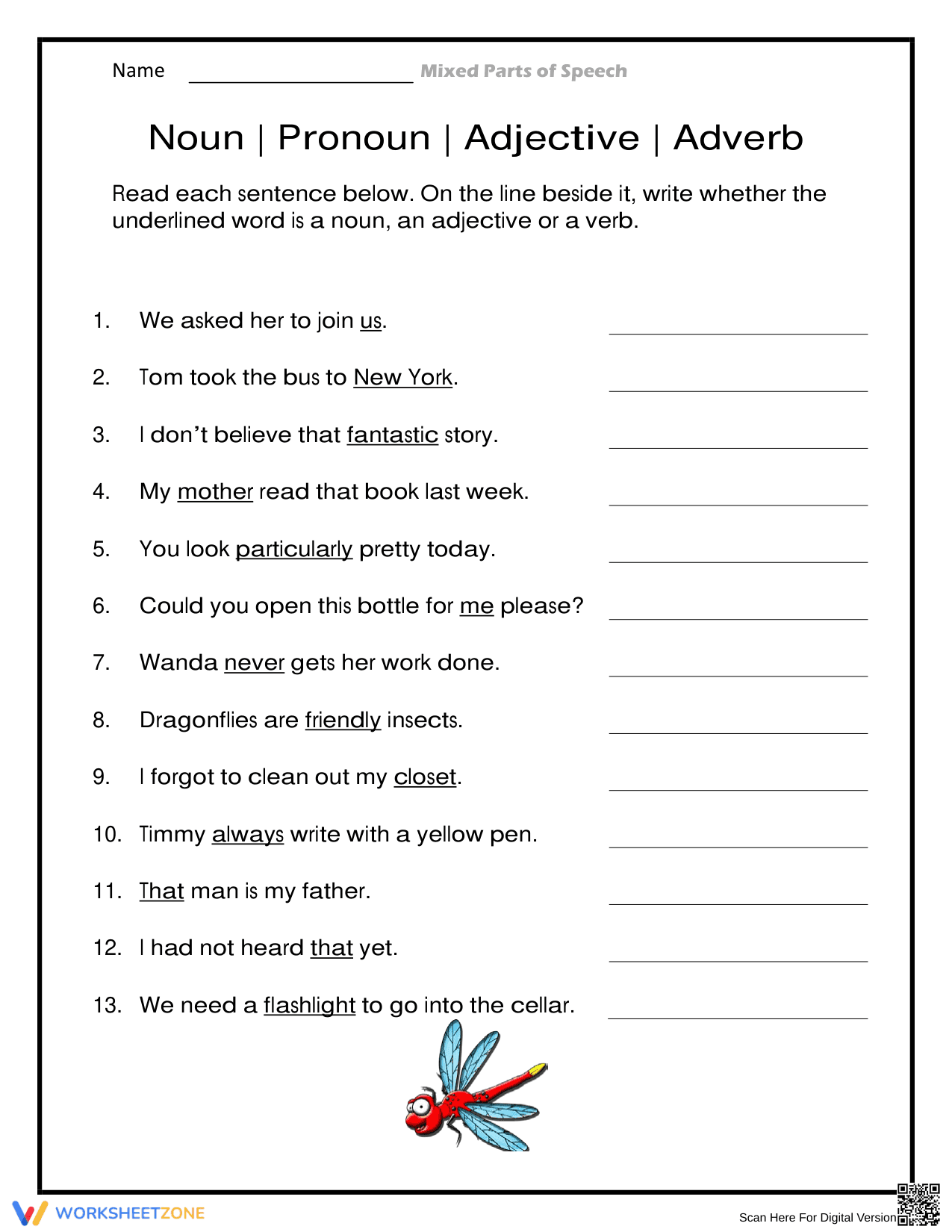

Essential Parts of Speech Worksheet | Grade 3-4 ELA

Paste this activity's link or code into your existing LMS (Google Classroom, Canvas, Teams, Schoology, Moodle, etc.).
Students can open and work on the activity right away, with no student login required.
You'll still be able to track student progress and results from your teacher account.
This comprehensive Grade 3-4 grammar worksheet helps students master the core parts of speech by identifying nouns, pronouns, adjectives, and adverbs within context. By analyzing thirteen unique sentences, learners strengthen their ability to recognize word functions, which is a foundational skill for improving sentence structure and overall writing clarity in elementary English Language Arts.
At a Glance
- Grade: 3–4 · Subject: Grammar
- Standard:
CCSS.ELA-LITERACY.L.3.1— Explain the functions of nouns, pronouns, verbs, adjectives, and adverbs in sentences- Skill Focus: Parts of Speech Identification
- Format: 1 page · 13 problems · Answer key included · PDF
- Best For: Independent practice or quick formative assessment
- Time: 15–20 minutes
What's Inside
This single-page PDF features 13 carefully constructed sentences, each containing an underlined word. Students must evaluate the word's role in the sentence and classify it as a noun, pronoun, adjective, or adverb. The layout includes clear horizontal lines for student responses, ensuring an organized workspace for young learners. A complete answer key is provided to facilitate rapid grading and immediate feedback.
Zero-Prep Workflow
- Print: Download and print the single-page PDF for your entire class in under 30 seconds.
- Distribute: Hand out the worksheets to students as a bell-ringer or independent practice activity.
- Review: Use the included answer key to review responses together in less than 5 minutes.
Total teacher preparation time is minimized, making this an ideal resource for substitute folders or last-minute lesson extensions.
Standards Alignment
The primary alignment is CCSS.ELA-LITERACY.L.3.1, which requires students to "demonstrate command of the conventions of standard English grammar and usage when writing or speaking," specifically by explaining the function of nouns, pronouns, adjectives, and adverbs. This resource also supports Grade 4 standards by reinforcing parts of speech recognition. Both standard codes can be copied directly into lesson plans, IEP goals, or district curriculum mapping tools.
How to Use It
Use this worksheet as a formative assessment during the "You Do" phase of a gradual release lesson on grammar. It allows teachers to observe if students can differentiate between similar word types, such as adjectives and adverbs, in a real-world sentence context. Alternatively, assign it as a morning work task to keep grammar skills sharp throughout the week, with an expected completion time of approximately 15 minutes.
Who It's For
This resource is designed for Grade 3 and 4 students, but it is also highly effective for Grade 5 learners who need a refresher on basic parts of speech. It serves as an excellent tool for English Language Learners (ELLs) who are developing their understanding of English sentence structure. The worksheet pairs naturally with a parts-of-speech anchor chart or a short introductory passage on grammar rules.
Mastering the classification of nouns, pronouns, adjectives, and adverbs is a critical milestone in early literacy development. According to the RAND AIRS 2024 report, students who receive consistent, explicit instruction in grammar and parts of speech demonstrate higher proficiency in both reading comprehension and technical writing. This worksheet provides thirteen targeted practice problems aligned to the CCSS.ELA-LITERACY.L.3.1 standard, focusing on the functional use of language. By requiring students to identify word roles within full sentences rather than isolated word lists, the resource promotes a deeper understanding of syntax and linguistic nuance. This approach mirrors best practices identified in recent NAEP assessments, which highlight the correlation between grammatical awareness and student achievement in English Language Arts. Educators can use this structured practice to bridge the gap between recognizing vocabulary and applying grammatical rules effectively in their own original compositions.


